
The 5-Minute Rule Hack: Defeat Procrastination in Seconds
Be honest. How many times have you gazed at your to-do list, muttering, “I’ll begin in five minutes”? And then? Instagram. YouTube. Dusting your desk. Anything but the task.
Hours vanish. Deadlines loom. Guilt gets heavier.
But here’s the reality: procrastination isn’t laziness. It’s fear. It’s perfectionism. It’s your brain selecting comfort over discomfort.
And the solution?
The very same “five minutes” you’ve been using as an excuse.
Welcome to the 5-minute rule hack — a ridiculously simple trick that flips procrastination into progress in less time than it takes to brew your coffee. Backed by psychology, productivity experts, and a sneaky bit of neuroscience, it’s the hack that turns “I’ll start later” into “I’ve already started.”
You’ll learn what the 5-minute rule hack is, how it works despite lack of motivation, and how to apply it to study, work, and everyday life. By the end you’ll have a useful playbook you can use today—in, yes, five minutes.
Table of Content
Table of Contents
What Is the 5-Minute Rule Hack?
The 5-minute rule trick is easy:
👉 Commit to working on a task for just 5 minutes.
If after 5 minutes you still don’t want to continue, you’re allowed to stop.
That’s all. No obligation to complete the task. No shame over productivity. Just five little minutes.
But here’s the twist: once you begin, momentum takes over. Anyone can do five minutes—people just do it. Why? Because the greatest challenge with any task isn’t performing it—it’s initiating it.
“Objects in motion tend to stay in motion.” – Newton’s First Law of Productivity
The Psychology Behind the 5-Minute Rule Hack
Procrastination isn’t laziness—it’s a self-preserving reflex. Your brain balances short-term pain (effort, fear of failure, boredom) against long-term benefit (a done report). Short-term always wins.
Core Mechanisms in Action:

- Activation Energy: Similar to cranking a cold engine, starting requires more energy than going. Five minutes brings down the “start barrier”.
- Dopamine Drip: Tiny progress releases a dopamine reward. That “micro-win” makes further progress appealing.
- Zeigarnik Effect: The Zeigarnik effect is a psychological state in which individuals better retain incomplete or interrupted tasks compared to finished ones. Our minds want to complete what’s begun. Once started, an open loop compels you to do more.
- Temporal Discounting: We overestimate comfort now versus rewards later. Five minutes makes the reward nearer to “now”.
- Perfectionism Disarmed: You’re not promising perfect output—just a small segment of effort. That breaks down the fear wall.
How the 5-Minute Rule Hack Neutralizes Common Barriers
| Psychological Barrier | How the 5-Minute Rule Hack Helps | Practical Cue |
|---|---|---|
| Fear of failure | Five minutes is too short to “fail”. | “Just open the file and add one sentence.” |
| Overwhelm | Shrinks scope to a bite-size action. | “List 3 bullets, not the whole plan.” |
| Low motivation | Creates a quick dopamine win. | “Start the timer and move your hands.” |
| Perfectionism | Prioritises starting over being perfect. | “An ugly first draft is allowed.” |
| Decision fatigue | Removes big decisions—just begin. | “Pick one micro-step from a preset list.” |
Why the 5-minute rule hack is effective is because it’s a negotiation your brain agrees with. It’s not a sprint of productivity; it’s a permission slip to begin.
How to Exactly Use the 5-Minute Rule Hack (Step by Step)
Step 1: Identify the Next Bodily Action
Fuzzy goals cause resistance. Reframe “complete proposal” as a micro action:
- Open file.
- Sketch a rough outline with 3 bullet points.
- Insert last quarter’s figures.
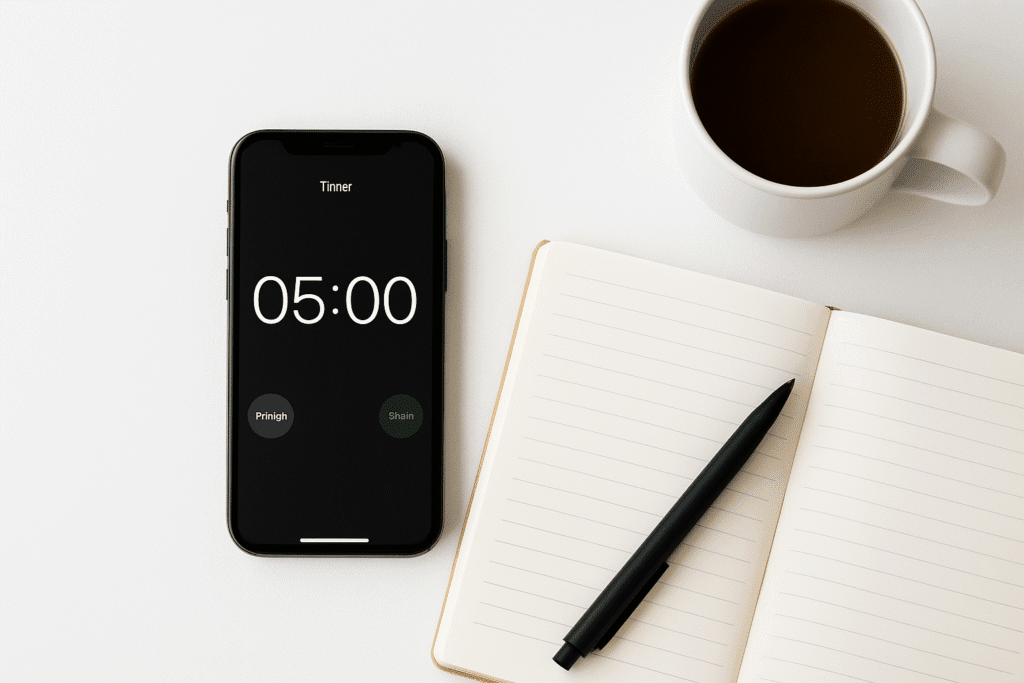
Step 2: Establish a Specific 5-Minute Timer
Use your phone timer, smartwatch, desktop clock, or a plain old kitchen timer. The boundary does count. The 5-minute rule hack isn’t “work vaguely for a bit”; it’s five dedicated minutes.
Step 3: Make the Start Frictionless
Pre-load the environment: Open the tabs, set the book on the desk, and lay out the gym shoes. Make setup time almost zero.
Step 4: Press Start and Move Your Hands
Don’t wait for motivation. Movement precedes motivation. The 5-minute rule hack begins with motion, not mood.
Step 5: At 5:00, Decide—Stop or Continue
You may stop. Sometimes you won’t want to. If you keep going, fine. If you do stop, fine too—the habit of starting is what you’re building.
Script: “I only owe five minutes. Future me can do more.”
When the 5-Minute Rule Hack Is Best (and When It Isn’t)
✅ Best For:
- Feeling less overwhelmed to begin.
- Simple tasks (writing, cleaning, calls).
- Establishing habits and consistency.
❌ Less Effective For:
- Extremely complicated projects with no obvious first step.
- Things that need intense concentration from the beginning (e.g., coding sprints).
- People who use it as an excuse to only ever work for 5 minutes.
Advanced Variations to Keep It Fresh
The 5-minute rule hack is a base move. Upgrade it with these practical twists:
1. The 5-5-5 Ladder
5 minutes to start, 5 to deepen, and 5 to clean up.
Works beautifully for writing, coding, or art.
2. The Ramp-Up Method (5 → 10 → 15)
Start at five. If it feels good, add ten. If not, stop.
Keeps autonomy high and resistance low.
3. Playlist Sprint
Work for the length of one song (~4–5 minutes).
When the track is over, the decision point comes naturally.
4. Doorframe Ritual
Each time you come into your work area, finish a five-minute micro-task.
Anchors the 5-minute rule hack to a physical cue.
5. Two-Tab Method
Tab 1 = today’s five-minute task. Tab 2 = resource/notes.
Close all other tabs for the five. Simplicity = progress.
A Gentle Warning: The Brain Loves Excuses
Anticipate resistance such as, “Five minutes won’t matter,” or “I’ll wait for the perfect time.” That’s the comfort-seeking side of your brain negotiating delay. The 5-minute rule hack is how you gently refuse the deal. You’re not starting a fight; you’re rewriting the engagement rules.
Mantra: “Five now beats perfect later.”
The Hidden Long-Term Benefits

At first glance, the 5-minute rule hack appears to be a quick fix. But consistently applied, it reprograms your mind.
- Creates Discipline → Little beginnings build consistency.
- Reprograms Identity → You no longer see yourself as a procrastinator.
- Compounds Over Time → 5 minutes a day = 30 hours a year of forward motion.
- Increases Confidence → Evidence that action is always available.
Final Thoughts
The 5-minute rule hack isn’t about fooling yourself into working. It’s about outsmarting your brain’s resistance. The creation of everything great—books, businesses, fitness goals—starts small. And the 5-minute rule hack provides you with that doorway. So the next time procrastination murmurs, “I’ll start later,” resist with:
👉 “I’ll just start for 5 minutes.”
Those 5 minutes most likely will turn into something more.
Keep in mind: five minutes can change everything.
What is it that you will attempt to hack with the 5-minute rule today?






One Comment